
Birth chart4 min read
Astrology glossary: the essential terms explained
The key terms of astrology defined simply: planets, houses, aspects, lunar nodes, synastry. A plain-language guide to understanding your birth chart.
Free birth chart availableCalculate your birth chart for free
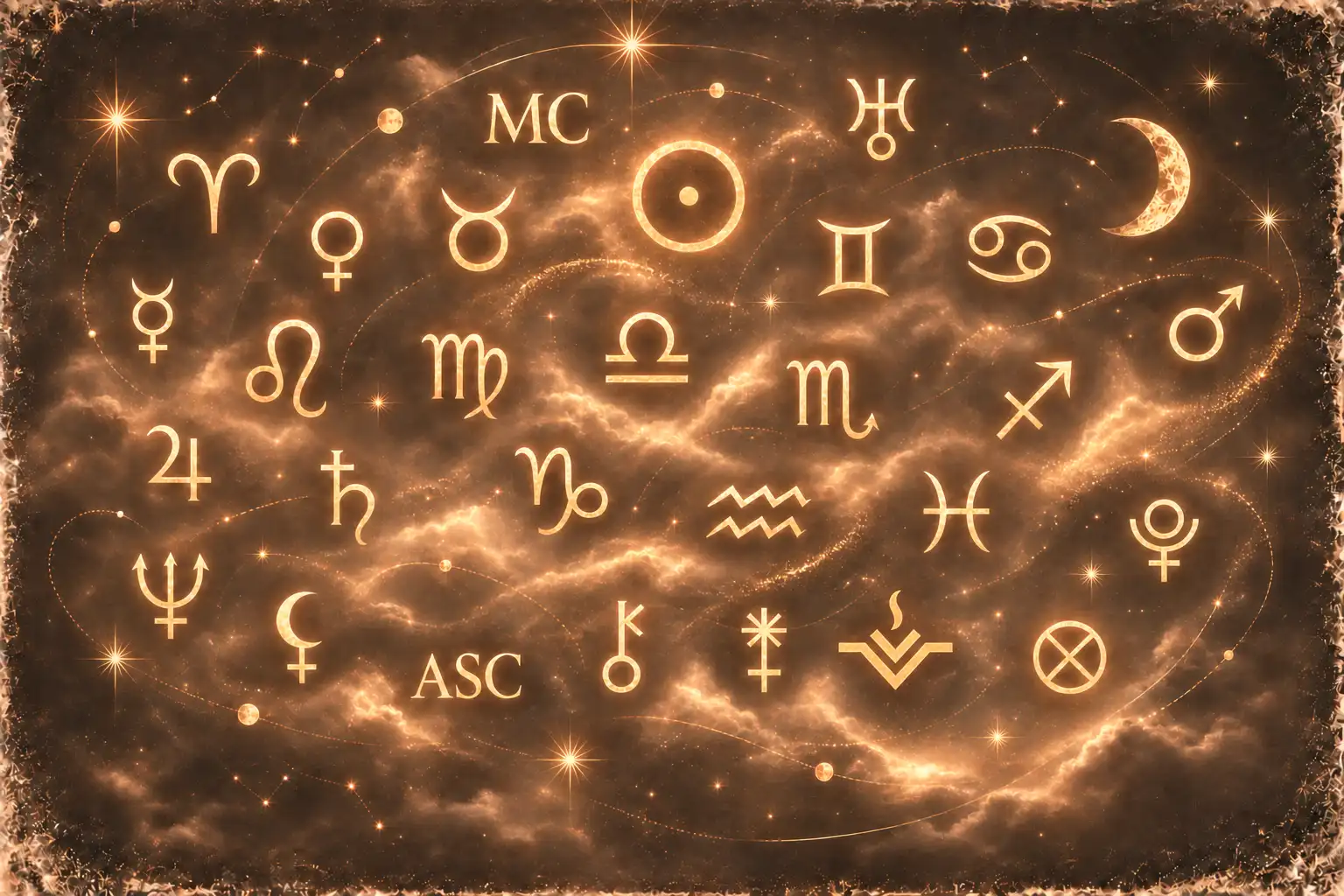
Understanding the vocabulary of your birth chart
Planets and luminaries
Sun. The heart of the chart: your identity, your vital drive, what you reach toward to feel alive. It is the famous "sun sign" of horoscopes, but only one piece among many. See the Sun in astrology.
Moon. Your inner world: emotions, deep needs, emotional memory, what makes you feel safe. It describes how you feel before you think. See the moon sign.
Mercury. How you think, speak, learn and connect ideas. See Mercury in astrology.
Venus. How you love, what attracts you, your relationship to pleasure, beauty and your own sense of worth. See Venus in astrology.
Mars. Your energy for action, desire, anger, the way you go after what you want. See Mars in astrology.
Jupiter. Expansion, confidence, the meaning you give to things, the areas where life opens up for you.
Saturn. Structure, maturity, limits and lessons. Wherever Saturn sits, you progress through effort and time. See the Saturn return, a pivotal passage around age 29-30.
Uranus, Neptune, Pluto. The transpersonal planets, slow-moving, marking a generation as much as an individual: freedom and rupture (Uranus), imagination and the ideal (Neptune), deep transformation and power (Pluto).
Luminaries. The term for the Sun and Moon together, the two lights of the chart, one turned toward identity, the other toward emotion.
Signs, angles and houses
Zodiac sign. One of the twelve sectors of the zodiac (from Aries to Pisces). A sign describes a style, a way of being, not an area of life.
Ascendant (rising sign). The sign rising on the horizon at the time of your birth. It colours your temperament, your bearing and the way you meet the world, and it sets the whole house system. See how to find your rising sign.
Descendant. The point opposite the ascendant: what you seek in another, what draws you and completes you in relationship. It sits on the cusp of the seventh house.
Midheaven (MC). The top of the chart: vocation, public image, professional direction, what you are seen rising toward.
Astrological houses. The twelve sectors that divide the chart into concrete areas of life (the body, money, partnership, work, family…). A planet in a house acts in that area. See the astrological houses.
Twelfth house. The house of the unconscious, the hidden, what works behind the scenes: fertile solitude, buried memory, inner trials. One of the most karmic sectors of the chart.
Aspects: the dialogue between planets
Aspect. The angle between two planets, which shows whether they cooperate, strain or merge.
Conjunction. Two planets at the same point: their energies blend, for better and for intensity.
Trine and sextile. The so-called harmonious aspects: energy flows easily, often like a natural talent.
Square and opposition. The aspects of tension: friction and pull, but also an engine of growth once you learn to inhabit them.
Orb. The margin of tolerance allowed for an aspect to count. The tighter the orb, the stronger the aspect.
Karmic and sensitive points
Lunar nodes. The axis of the north and south nodes, which describes your direction of growth. The south node speaks of what is already known, acquired and automatic; the north node points to the path to dare, uncomfortable but full of growth.
Black Moon (Lilith). A calculated point, not a body: the apogee of the Moon's orbit. It describes your untamed part, your deep refusals, what will not bend. See Black Moon Lilith.
Chiron. The asteroid of the "healing wound": the fault line you carry that, once worked through, becomes a source of help to others. See Chiron in astrology.
Juno. The asteroid of lasting commitment: what you seek in alliance, partnership and loyalty. See Venus and Juno.
Karmic astrology. A reading that looks at what repeats from one life, story or lineage to the next, through the nodes, Saturn, the twelfth house or the Black Moon. See the karmic relationship.
Transgenerational. What is passed down and replayed from one generation to the next, readable in the echoes between the charts of a single family. See generational astrology.
Relationship readings
Synastry. The comparison of two charts to understand a relationship: what attracts, what wounds, what repairs, what replays between two people. See synastry.
Composite chart. A single chart calculated from both, describing the relationship itself as an entity with its own dynamic. See the composite chart.
Transit. The passage of a current planet over a point in your birth chart: this is what "activates" the chart in the present and describes the cycles you are moving through.
This glossary is only a doorway. To see how these notions connect in your own sky, you can calculate your free birth chart or, for a personal and grounded reading, explore my birth chart reading.
Frequently asked questions
What is a birth chart?
A birth chart is the map of the sky at the moment you were born, calculated for an exact date, time and place. It plots the planets, signs and houses as they stood at that instant. It is read as a map of the strengths, wounds and patterns of a life, not as a fixed fate.
What is the difference between a sign and a house in astrology?
A sign describes a way of being (the style of an energy); a house describes an area of life where that energy plays out (love, work, family). The same planet takes on a different meaning depending on the sign it occupies and the house it falls in.
What is an aspect in astrology?
An aspect is an angle measured between two planets in the chart. It shows whether their energies cooperate (trine, sextile), strain against each other (square, opposition) or merge (conjunction). Aspects are the grammar of the chart: they link the planets into a coherent story.
What if your chart could light your path?
I read your birth chart with you over video: your strengths, your wounds, your patterns and your path of growth.
Explore the birth chart readingVideo consultation, by appointment.
Read next
All articlesBirth chart
Uranus in astrology: the planet of your freedom
Uranus in astrology governs freedom, individuation and the ruptures that wake you up. What Uranus means in your birth chart, by house and in relationships.
Birth chart
Your Mercury sign: how you think and communicate
Your Mercury sign reveals how you think, learn and communicate. Learn what Mercury means in your birth chart, by sign and house, and its natal cycles.
Birth chart
The 8th house in astrology: intimacy and transformation
The 8th house rules intimacy, shared resources, and deep transformation. Learn what the 8th house means in your birth chart and what planets there reveal.