Birth chart5 min read
How to read your birth chart: a complete beginner's guide
Learn how to read your birth chart step by step: Sun, Moon, rising sign, planets, houses, and aspects, with a simple method to decode your natal chart.

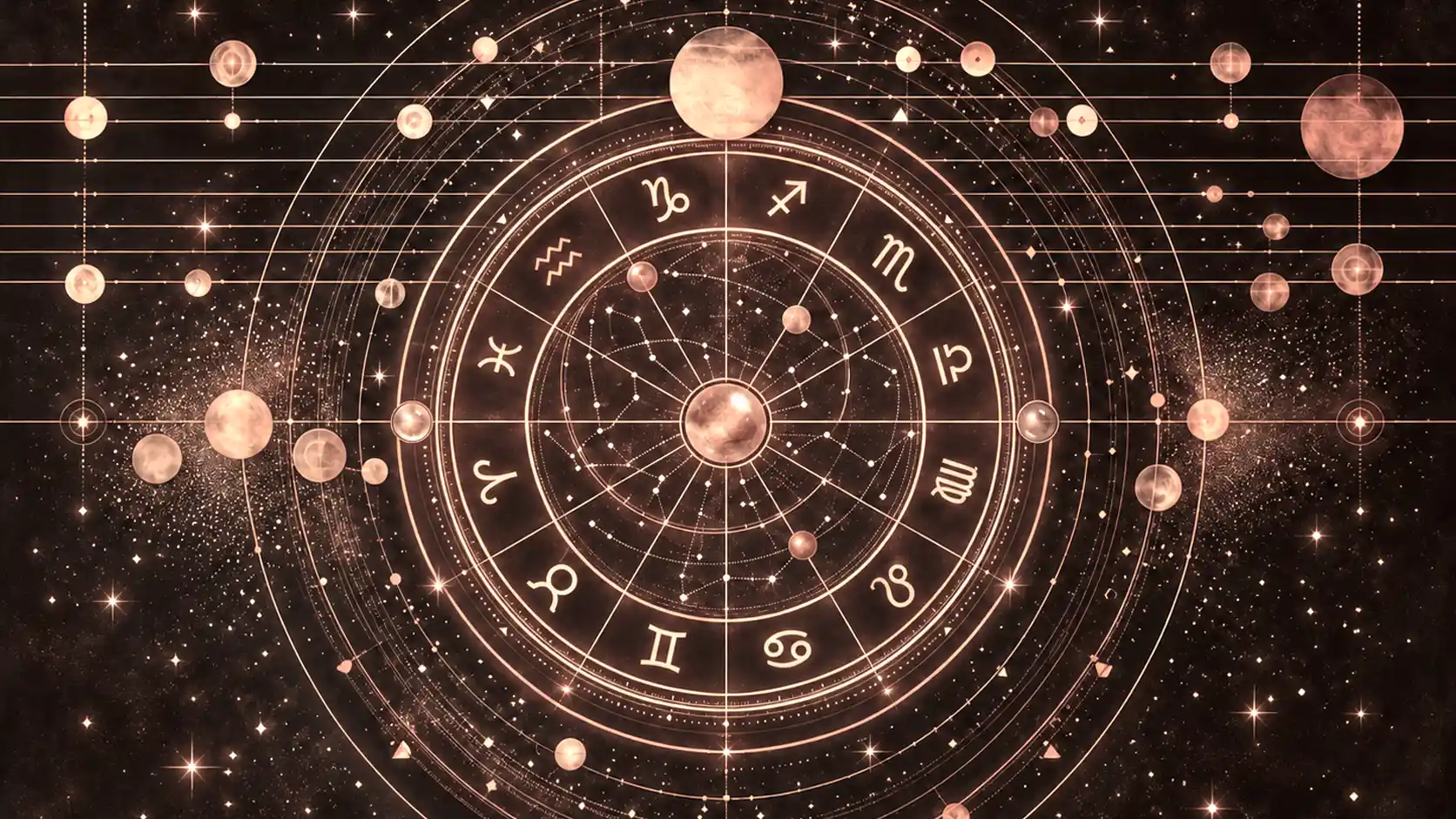
How do you read a birth chart when you are new to astrology?
Your birth chart is a snapshot of the sky at the exact moment you were born: the position of the Sun, the Moon, and the planets, seen from your birthplace. Many people generate their chart for free, look at it for a minute, and close the tab none the wiser. That is normal: a chart is not a list of symbols, it is a system where each element means something only in relation to the others. Here is a method, in order, to turn that intimidating wheel into a portrait that speaks to you.
What is a birth chart, exactly?
A birth chart (or natal chart) is a circular map divided into twelve sectors. To cast it, you need three precise details: your date of birth, your exact time of birth, and your place. The time is essential, because it sets your rising sign and the position of the houses. Without an accurate time, you can read the signs of the planets, but not the full structure of the chart.
The wheel holds four layers: the planets (what acts in you), the signs (how it expresses itself), the houses (the area of life involved), and the aspects (how the planets relate). Reading a chart means making those four layers talk to each other.
The big three: Sun, Moon, and rising sign
Before any detail, find your three foundational points. They already sketch a coherent portrait.
- The Sun: your core identity, your will, your life direction. This is your everyday "star sign".
- The Moon: your inner world, your emotions, your need for security, your most private self. To go deeper here, see your moon sign.
- The rising sign: the sign rising on the horizon at your birth. It is how you meet the world and the first impression you give.
When these three agree, your energy flows in one direction; when they differ (a fiery Sun, a watery Moon), you carry a fertile inner tension that explains many of your "why am I like this?" moments.
What the planets mean
Each planet carries a psychological function. You always read it with its sign (how) and its house (where).
| Planet | What it governs |
|---|---|
| Sun | Identity, will, life direction |
| Moon | Emotions, memory, need for security |
| Mercury | Thinking, communication, learning |
| Venus | Love, values, pleasure and beauty |
| Mars | Action, desire, energy, how you assert yourself |
| Jupiter | Expansion, confidence, meaning, opportunity |
| Saturn | Structure, limits, responsibility, maturity |
| Uranus, Neptune, Pluto | Deep transformation, over long generational cycles |
The personal planets (Sun through Mars) describe your day-to-day functioning. The slow planets color the larger movements of a life and a generation.
The twelve houses: where it plays out
If the planets say "what energy" and the signs say "in what manner", the houses say "in which area of life". The wheel has twelve houses: the 1st house relates to your personality, the 7th to relationships, the 10th to career, the 4th to home and roots, and so on. A planet takes on a very concrete color depending on its house. Venus in the 5th house (romance, play) is not lived the same way as Venus in the 10th (public image). For a deeper look at one of the most transformative houses, see the 8th house in astrology.
The aspects: how planets talk to each other
Aspects are the angles planets form between them, showing whether energies cooperate or clash. The main ones:
- Conjunction (0°): two planets merge and reinforce each other.
- Trine (120°) and sextile (60°): smooth flow, natural talents, ease.
- Square (90°) and opposition (180°): friction, but also an engine of growth.
A chart with no tension would be flat; it is often the squares we end up thanking, because they push us to evolve.
How to start reading, step by step
A simple method so you do not drown:
- Note your big three (Sun, Moon, rising) and read what they say first.
- Spot the clusters: are several planets in one sign or house? That is an area of intensity in your life.
- Look at the personal planets one by one (Mercury, Venus, Mars) with their sign and house.
- Pick two or three key aspects only, not all of them: the tightest ones and those touching the Sun or Moon.
- Connect it into a story rather than stacking definitions.
Do you need an astrologer to go deeper?
You can learn the basics on your own and gain a lot from them. But a full chart holds dozens of intertwined factors, and it is precisely in the nuances, the apparent contradictions, and the repeating patterns that the essential lives. Cycles like your Saturn return add another layer of timing to the picture. An experienced outside eye helps you tell what truly reflects you from what you project.
If you would like a personal, in-depth reading of your natal chart, explore a birth chart consultation: a space to decode, together, what your sky at birth has to tell you, and turn it into a real lever for moving forward.
Frequently asked questions
Can I read my birth chart for free?
Yes. Many sites calculate your natal chart for free from your date, time, and place of birth. The calculation is free, but the deeper interpretation, the part that connects the pieces together, takes method or the help of an astrologer.
What information do I need for a birth chart?
Three precise details: your date of birth, your exact time of birth, and your place. The time is essential to calculate your rising sign and place the houses; a few minutes can change the reading.
Where should I start when reading a birth chart?
Start with the big three: your sun sign, your moon sign, and your rising sign. These three points already give a coherent portrait before you move into the detail of planets, houses, and aspects.
What if your sky could light your path?
Dorothée Casanova reads your birth chart with you, to turn your doubts into levers for growth.
Order an analysisOnline consultations, by appointment.
Read next
All articlesBirth chart
Your Mercury sign: how you think and communicate
Your Mercury sign reveals how you think, learn and communicate. Learn what Mercury means in your birth chart, by sign and house, and its natal cycles.
Birth chart
The 8th house in astrology: intimacy and transformation
The 8th house rules intimacy, shared resources, and deep transformation. Learn what the 8th house means in your birth chart and what planets there reveal.
Birth chart
The 12 astrological houses explained: a simple guide
The 12 astrological houses show where each planet plays out in your life, from identity to relationships and career. Learn what each house means, simply.